.png)


Somewhere in your product category, right now, a consumer is asking an AI agent a question your brand should be answering — and getting silence, a hedge, or a competitor's name instead of yours.
Not because your product is wrong for them. Because the question sits in a white space.
What a white space actually is
A white space is a category purchase-intent question — the kind a real buyer types or speaks before they buy — that no brand is currently winning inside AI search. Ask an AI shopping agent "which trail runner holds up best in wet conditions" or "what's the best retinol for sensitive skin," and in a growing number of categories, the honest answer is that the agent doesn't confidently recommend anyone. It lists a few options with qualifiers. It hedges. Or it simply doesn't surface a clear answer at all.
That absence is the white space. It's not a keyword gap in the SEO sense — nobody has failed to rank for a page. It's a trust gap. The AI has no verified evidence strong enough to put a brand name behind a confident answer, so it declines to commit. The query exists, the intent is real and often high-value, and no one owns it.
Why white spaces exist
White spaces open up for a simple structural reason: AI agents don't recommend on the basis of product copy. They recommend on the basis of evidence they trust enough to stake their own credibility on. A brand's own product description carries almost no weight here — it's a self-interested source describing itself, and every AI system already discounts it accordingly.
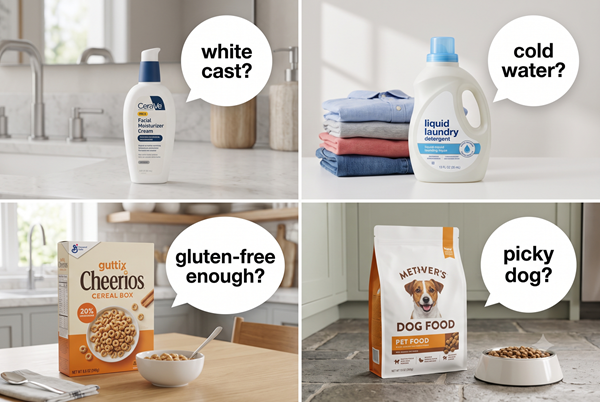
Most categories are still supplying exactly that kind of evidence: polished copy, spec sheets, static reviews. What's missing is the layer AI agents actually rely on to answer high-intent, personal questions — specific, verifiable, third-party proof tied to the actual question being asked. "Does this work for wide feet?" "Does this leave a white cast on darker skin?" "Is this safe for a specific breed?" These are the questions with real purchase intent behind them, and they're exactly the questions where most brand catalogs currently have nothing an AI agent can confidently cite.
The result is a category sitting there, fully searched, fully intent-rich, and completely unclaimed waiting for whichever brand shows up first with proof strong enough for an AI agent to act on.
The race: capture the flag
Here's what makes this moment different from a normal content gap. White spaces don't stay open indefinitely, and they don't get divided up evenly once a brand moves in.
AI systems weight sources partly on track record. Once an agent has repeatedly seen strong, verified evidence behind a brand's claims in a category, that brand becomes the trusted default — not just for the question it originally answered, but for adjacent questions and future products too. The first brand to fill a white space with credible, specific evidence doesn't just win that query. It starts accumulating a credibility position that later entrants have to work much harder to dislodge, because they're now asking the AI to override an answer that's already working.
That's the capture-the-flag dynamic. It isn't first-come-first-served in the sense of a small edge — it's closer to planting a flag that gets harder to remove the longer it stands. Every week a whitespace stays open is a week a competitor could claim it instead, and every week after that is a week your competitor's claim compounds.
The SEO parallel, and why it should worry you
This isn't a new pattern. It's the SEO land grab, one generation later.
In the early 2000s, brands that understood search structure early built a durable lead. Amazon became the default answer to "where do I buy this" not because it had the best product page, but because it built scale, data, and trust advantages early enough that later entrants couldn't just outspend their way past it. Google itself compounded a technical head start into a category-defining position by building capabilities nobody else had built yet, at a moment when there was no established playbook to follow.
The honest caveat from that era matters too: not every first mover wins. Plenty of early entrants — in search and elsewhere — burned their advantage through weak execution, while smart fast followers who moved decisively (not passively) captured the larger share. The lesson isn't "be first and relax." It's "be early and be right." The early SEO winners weren't the ones who showed up first with thin content — they were the ones who showed up early with something genuinely more credible than the alternative, and kept building on it.
AI search is repeating this pattern on a faster clock. The category structures are still forming. The winners a decade from now are being decided in the next 18 months, in exactly the way the winners of organic search were decided in the mid-2000s — quietly, category by category, before most of the market realized the race had started.
What's different this time
There is one meaningful difference, and it cuts against complacency, not for it. SEO rewarded structure and volume — you could out-publish a slower competitor. AI search rewards verifiable evidence, which is harder to fake and slower to build. You can't out-publish your way into a white space with more content; you need proof an AI agent will actually trust. That raises the bar for entry, which is bad news if you're behind and good news if you're building the right foundation now — because it means a determined, well-resourced competitor can't simply throw budget at the problem and catch up overnight. The moat, once built, holds better than an SEO-era moat did.
That's also exactly why waiting is expensive. The categories with real question density and real purchase intent are getting claimed on a rolling basis, right now, by whichever brand in that category moves first with something an AI agent can actually stand behind.
Where this leaves you
Somewhere in your catalog, there's a question your best customers are already asking an AI agent — and a white space sitting open around it, waiting for whoever shows up first with proof strong enough to close it.
SimplicityDX identifies exactly where those white spaces sit in your category, maps the specific purchase-intent questions driving them, and builds the plan to close them with verified, AI-agent-readable evidence before your competitors even know the race has started.
The flag is there. Someone is going to plant it.