.png)


At a recent Shoptalk event, an executive for a $10 billion global brand I was chatting with shrugged off AI’s impact on online retail with a observation:
“We’re just not seeing much traffic come from AI.”
It is a common perspective across enterprise e-commerce—and it relies on an outdated mental model. Judging AI’s role in commerce by tracking web referral traffic is like judging billboard performance by counting how many people walk into a store holding a photograph of the sign.
AI isn’t sending shoppers to your website; it’s making decisions for them long before they arrive.
Tracking direct AI referral traffic misses the entire shadow funnel that artificial intelligence creates. Measuring AI's true bottom-of-funnel influence requires shifting focus away from website traffic and toward Retrieval-Augmented Generation (RAG) queries and Universal Commerce Protocol (UCP) handshakes.
1. The Referral Traffic Illusion
Unless a shopper explicitly asks Google AI Mode / Overviews, ChatGPT or Perplexity, “Where can I buy Brand X?”, you should not expect to get a link.
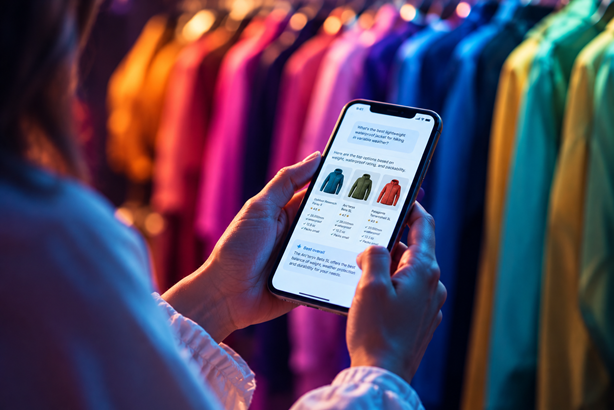
When consumers already know the exact brand they want, they go straight to the URL or open an app. AI enters the buyer journey during intent formulation, option narrowing, and feature comparison.
Shoppers don't ask for direct links. They ask queries like:
“What are the best non-comedogenic moisturizers under $50 for sensitive skin?”
“Compare lightweight two-person tents rated for high-wind alpine conditions.”
The Shadow Funnel
The LLM evaluates options, parses product specifications, synthesizes consumer reviews, and returns a shortlist. Frequently the shopper then opens a separate browser tab, searches for the chosen item, verifies the details on the brand’s site, and checks out.
Data from Digital Commerce 360 shows that AI referrals account for only a low single-digit percentage of direct site visits. Yet, AI did 90% of the persuasion. When that shopper converts, traditional web analytics credit the sale to "Direct Traffic," "Organic Search," or "Brand Paid Search."
Looking for direct traffic from AI is looking at the wrong metric entirely.
2. The Real Bottom-of-Funnel Signals: RAG & UCP
Instead of counting clicks, brands must track data retrievals.When an AI engine evaluates products on behalf of a user, it relies on real-time data to ensure it isn't recommending out-of-stock inventory or obsolete pricing. This evaluation manifests in two primary ways depending on your tech stack:
Signal A: The RAG Retrieval Request
When a consumer asks a complex shopping question, AI engines perform Retrieval-Augmented Generation (RAG). The AI bot crawls indexed web pages, structured schema, or publicly exposed APIs in real time.When an AI user-agent (like GPTBot, ClaudeBot, or PerplexityBot) triggers a RAG retrieval against a specific product page, variant list, or policy document:It is a high-intent evaluation event: Unlike general web crawlers indexing a homepage, a RAG request targeting specific product variants means an active buyer is shortlisting that item.
It functions as an implicit cart event: RAG retrieval is the digital equivalent of a high-intent shopper asking a store associate to check inventory in the stockroom.
Signal B: The UCP API Handshake (Shopify & Protocol-Enabled Stacks)
For brands running on standardized ecosystems—most notably platforms utilizing the Universal Commerce Protocol (UCP) co-developed with Shopify and Google—the signal shifts from HTML web scraping to structured API handshakes.In a UCP-enabled environment, AI agents do not scrape web pages. Instead, they interact via standardized Model Context Protocol (MCP) servers and Storefront APIs.
When a Shopify store processes a UCP discovery request, a catalog lookup, or a draft cart session generated by an external AI agent:The data signal is clean and explicit: Rather than inferring intent from bot visits to an HTML page, UCP logs explicitly show when an AI agent verifies stock, fetches variant pricing, or prepares a checkout payload.
Both RAG and UCP offer bottom-of-funnel visibility: Whether your architecture receives an unstructured RAG crawl or a structured UCP API hit, both represent real-time product consideration by an active shopper.
3. What E-Commerce Leaders Must Track Instead
To understand brand reach across AI platforms, ditch traditional referral reports and measure these three core indicators:
Summary: Stop Waiting for the Click
The $10 billion brand looking for AI referral traffic is waiting for a behavior pattern that doesn't fit how modern consumers use LLMs.
AI isn't a traffic generation channel—it is an answer engine and an automated shopping assistant. By monitoring RAG retrieval requests on web servers and UCP API transactions within platform architectures, e-commerce leaders can finally measure the invisible bottom of the funnel.