.png)


Here is a number that stopped me in my tracks. In its Q2 2026 Quarterly Search Report, the SEO agency Victorious asked eight AI platforms to describe a cohort of 150 brands across five industries. The AI got it right 96% of the time. It knew who these brands were and what they did.
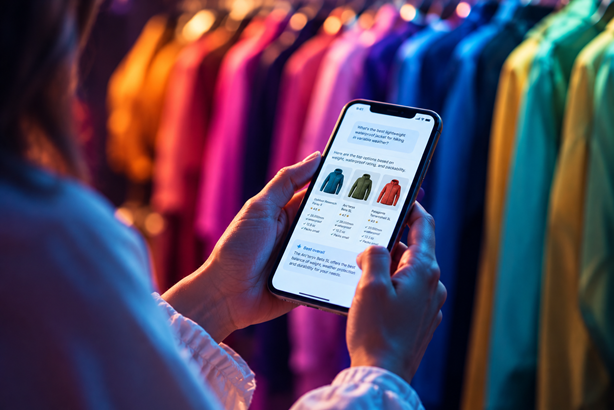
Then Victorious asked the questions that shoppers and buyers actually ask: category and buying-research prompts, the "what's the best…" kind. In those answers, 90% of the brands never appeared at all. Wow.
Picture a stage with a dozen products on plinths and a single spotlight. The AI can see every one of them but it only highlights one.
So this isn't a story about AI not knowing you exist. Nearly nine in ten brands are recognized and still left out of the spotlight, out of the conversation with the shopper where the decision actually gets made.
What "ignored" means here
It's worth being precise, because the number is easy to overstate. Victorious measured whether a brand appeared in AI-generated answers to category prompts. "Ignored" means never mentioned. The cohort spans ecommerce, SaaS, healthcare, legal and financial services, so this is a cross-industry finding, not an ecommerce-only one. It's also one dataset from one quarter, and we'd treat it as a strong signal rather than a universal constant. So we ran some of our own tests in ecommerce specifically and our research team came back with very similar numbers, with some variation by category.
Its pretty clear to me that recognition and selection are different behaviors, and most brands are winning the first and losing the second.
The obvious response is only half an answer
The industry's instinct has been to treat this as a findability problem: structure the content better, tighten the schema, make everything easier for AI to parse. Its familar SEO territory. That work is worthwhile, and AEO and GEO practitioners are doing it well.
But findability doesn't explain a gap where the AI already knows the brand. If recognition is at 96%, the missing piece isn't "can the AI find you." It's something further along: whether the AI is willing to put you in the spotlight.
Your own website rarely gets the credit
Victorious also analyzed 49,391 citations across 5,830 AI-generated answers on six platforms. 99.99% of those citations pointed to third-party websites. Only 4 of the 150 brands received a single citation to their own domain. Our own research echoes this - for a category search you should not expect to get a link to your site.
But its more nuanced that this because the AI may well have used your site content but not given you credit (aka a Ghost Citation). What the data shows is that the sources AI is willing to point to are almost never the brand itself. This, of course, is why AI has great influence on purchases, but many brands aren't seeing huge amounts of traffic from AI. We've written about Ghost Citations and how to measure the impact of AI here if you want to dig in.
We'd argue that distinction is the whole story. An AI system that protects its own credibility with users has good reason to be cautious about crediting a claim whose only source is the company making it. A product page saying a product is great is information. It isn't evidence.
Who AI puts in the spotlight
Muck Rack's What Is AI Reading? study points the same way from a different angle. Its May 2026 edition analyzed more than 25 million links from ChatGPT, Claude and Gemini responses across 17 industries. Earned media accounted for 84% of citations. Paid and advertorial content accounted for 0.3%. Journalism alone made up 27%.
Two details stand out.
First, the pattern is stable: across the three editions of the study going back to July 2025, earned media has stayed between 82% and 89%. That looks like how these systems source information, not a quirk of one model update.
Second, the split is stark: paid media barely registers, while content others independently produced dominates.
Put the two studies side by side and a pattern emerges. AI leans on what other people say about a brand and discounts what the brand says about itself.
Volume or evidence?
Victorious draws a practical conclusion from its own data: build broad third-party visibility. It found that brands with more third-party web mentions were more likely to appear in AI answers, with roughly a 50% chance of a mention at about 20,000 indexed third-party mentions. That's useful, and we agree with the direction.
We'd question though a reliance on volume of mentions because they are a blunt instrument. A brand with hundreds of products, each making specific claims (will it fit, will it last, does it work for someone like me), can't earn its way into AI answers one press mention at a time. What an AI system needs before it will stand behind a claim is evidence it can check: who said it, whether they have any expertise, and where the proof is. (Google has a framework for assessing content called EEAT which is covered in more detail here).
What this means for ecommerce brands
For product categories, the sources AI relies on look different from those in legal or healthcare. Victorious found that ecommerce citations were spread across thousands of domains, with Google, Reddit, YouTube, Walmart and Amazon among the most cited. That's a mix of community voices, video and marketplaces, and very little of it is written by the brand.
The common thread is real people talking about real products, in places the brand doesn't control. Press coverage helps at the brand level. But the questions shoppers ask AI are usually product-level and personal, and answering those takes independent testimony tied to specific claims.
What to do now
You don't need a new platform to start learning where you stand.
1. Test the prompts that matter. Run the category questions your buyers ask across the AI platforms they use, and note whether you appear, how you're described, and who gets cited instead.
2. Audit your claims. List the five or ten claims you most need AI to repeat. Next to each, mark whether independent proof exists somewhere a system can find it.
3. Close the gap where the proof is missing. Prioritize the products and claims with real demand and no independent evidence, and get that evidence into a form AI can read and check.
From known to spotlit
AI can't recommend what it doesn't trust. The 90% aren't out of the spotlight because AI has never heard of them. They're there because being known and being believed are different things, and most brands haven't yet given AI a reason to believe them.
The spotlight goes to the brands AI can verify. The good news is that this is learnable, and most of your competitors haven't started.
Join the briefing: Get Recommended
If you want to understand how this works in practice, we're running a free educational briefing on best practices for getting into the AI spotlight. It's built for learning: how AI recommendations are actually made, and what the brands that get cited do differently.
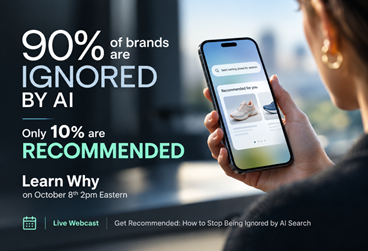
Get Recommended: How to Stop Being Ignored by AI Search
Thursday, October 8, 2026 · 2 PM ET · Free and online
You'll learn:
• The anatomy of an AI recommendation: how AI moves from simple retrieval to deciding who makes the final shortlist.
• Why AEO and GEO aren't enough on their own: why optimizing content for crawlers solves less than half the equation.
• How to build the verification layer: how to structure third-party evidence so AI search engines can cite your claims with confidence.
• Live query teardowns: real examples of why some brands get cited while others stay in the dark.
• Plus your opportunity to ask the experts in a live Q&A session
It's designed for leaders at consumer brands, retailers and agencies who want to understand how to increase visibility in AI search.
Learn more and reserve your place for the briefing here.