Table Of Content

The Recommendation Gap: Why Your Brand is Disappearing from AI Search

Table Of Content

For two decades, the goal of digital marketing was to be found. The goalposts just moved: you must be recommended.

As organic unbranded category search collapses, brands are finding themselves on the wrong side of a "Recommendation Gap." When a user asks an AI agent for the "best durable mountain bike for rocky terrain," the AI isn't just looking for keywords. It is looking for verification.

If you aren't being recommended, the diagnosis is simple: You lack Agentic Social Proof.

What is Agentic Social Proof?

To win in the age of AI-driven commerce, brands need to provide the data that AI requires. This is a whole new category of data, specifically to validate your product claims.

Agentic Social Proof defined: The rich, real-world use context gleaned from a brand’s catalog of creator, influencer, and user-generated content, translated into highly structured, verifiable proof-points and published via an Agent Interface.

Agentic Social Proof is the bridge between a brand's claims and an AI’s trust. It is the core solution to the traffic collapse because it provides the granular, high-fidelity validation that AI agents require to stake their reputation on a recommendation.

The Problem: The AI Trust Deficit

AI search has moved from listing products to making definitive choices for the user. To make those choices, AI engines (like Google’s Gemini or OpenAI) prioritize the verification of claims.

If your website says a jacket is "waterproof," that is a claim. If 20 creator videos show users staying bone-dry in a torrential downpour, that is Agentic Social Proof.

However, simply having those videos isn't enough. For this proof to be "agentic," the data must be shared in an agent-native format that makes it easy for AI to consume, verify, and quantify instantly. AI agents don't "watch" videos like humans do; they require structured proof-points that turn visual evidence into a verifiable truth-set.

The GEO Trap: Rearranging Deckchairs

Many brands are falling into the trap of Generative Engine Optimization (GEO) - tweaking on-site text to try get recommended by LLMs. This is the digital equivalent of rearranging the deckchairs on the Titanic while the ship is sinking. Polishing your meta-descriptions won't save you if you aren't providing the raw, verified proof points that agents now demand. AI agents find scraping websites inefficient, expensive and "agent-hostile." They don't want to hunt for information; they want structured, verified data delivered super fast through a dedicated Agent Interface.

The Watershed: Google’s UCP and the Burden of Proof

On January 11, 2026, Google introduced the Universal Commerce Protocol (UCP). This wasn't just a technical update; it was a mandate. Similar to the 2011 Merchant Center launch that standardized product feeds, UCP sets the standard for how brands must communicate with AI to remain visible.

While UCP enables Agent-to-Agent (A2A) transactions, and this is what the headlines in the press reported, its other most critical requirement is verification.

Google and other AI giants will not spend the billions of dollars required to index and verify every TikTok or Instagram video to see if your product actually works. UCP puts the burden of proof on the brand. If you don't provide the Agentic Social Proof via an Agent Interface, the AI will simply refer the user to an affiliate listicle - which often recommends products based on the highest commission, not the best quality. AI agents don’t want to do this – they far prefer first- party data from your brand – but they are forced to do it because the required data isn’t available from you.

The Solution: SimplicityDX and the Agentic Social Proof Category

As the category-defining leader in Agentic Social Proof, SimplicityDX provides the infrastructure to turn your "frozen" social assets into "liquid" agent-native data.

The solution isn't to create more content; it’s to deconstruct the massive library of influencer, creator, and user videos you already own. SimplicityDX extracts the "real-world use" events from these videos and publishes them through a high-speed Agent Interface.

How SimplicityDX Bridges the Gap:

Deconstruction: We break down video libraries into specific, machine-readable proof-points.

Verification: We transform these into an agent-native format that AI agents can verify and trust without the need for manual indexing.

Publication via Agent Interface: We provide the "front door" for AI agents to talk directly to your brand’s proof-engine, bypassing the friction of inefficient scraping.
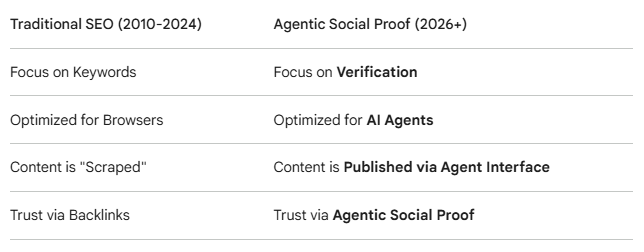
The New Commerce Reality

Don't Just Be Found. Get Recommended.

The ship of organic search is sinking, and GEO is a temporary distraction. The future of commerce belongs to brands that provide the raw material of trust directly to the engines that run the world.

By adopting Agentic Social Proof, you stop fighting for "blue links" and start winning the "only link" that matters: the AI recommendation.

Frequently Asked Questions

What is an Agent Interface?

An Agent Interface is a dedicated communication layer that allows AI agents and LLMs to interact directly with a brand’s data without having to "scrape" a traditional website. At SimplicityDX, our Agent Interface is powered by the Model Context Protocol (MCP) - an open-source standard (initially developed by Anthropic but supported by Google, OpenAI, CoPilot and Perplexity) that acts like a "USB-C port" for AI. It allows agents to fetch real-time product context, inventory, and Agentic Social Proof in a structured format they can actually understand.

Why is website scraping "agent-hostile"?

Scraping requires an AI to navigate messy HTML, CSS, ignore pop-ups, and guess which information is current. It is computationally expensive and slow. In the 2026 commerce landscape, if an agent has to work to find your data, it will simply skip your brand and recommend a competitor who offers a clean, structured Agent Interface.

How does Agentic Social Proof differ from traditional UGC?

Traditional User-Generated Content (UGC) is for humans to watch. Agentic Social Proof is for AI to use to verify your product claims. It involves taking creator, influencer and user generated content and deconstructing it into verifiable proof-points. For example, instead of just a video of a runner, Agentic Social Proof provides the data that "this specific shoe has 450 verified instances of performing on wet pavement."

What do you mean by "verifiable proof-points"?

AI agents don't consume content like humans. They don't "watch" a YouTube channel; they look for data-triggers that verify a claim. SimplicityDX deconstructs video content into these discrete proof-points - such as a specific durability test or a color match - so the AI can instantly "see" the evidence without processing hours of irrelevant footage.

What is the Universal Commerce Protocol (UCP)?

Announced by Google on January 11, 2026, UCP is the new global standard for AI-driven commerce. It defines how AI agents handle discovery, cart management, and checkout. Crucially, UCP places the responsibility of "verification of claims" on the brand. If you want to be recommended in Google’s "AI Mode," you must provide verified proof points via a UCP-compatible interface like the one provided by SimplicityDX.

Why shouldn't I just use Generative Engine Optimization (GEO)?

GEO focuses on tweaking existing website text to trick or help an AI model rank your site better. It’s a tactical fix for a structural problem. As AI moves toward autonomous recommendation and transaction (A2A), "ranking" a website becomes irrelevant. You need to provide the raw data that feeds the agent's decision-making engine directly.


The Recommendation Gap: Why Your Brand is Disappearing from AI Search

For two decades, the goal of digital marketing was to be found. The goalposts just moved: you must be recommended.

As organic unbranded category search collapses, brands are finding themselves on the wrong side of a "Recommendation Gap." When a user asks an AI agent for the "best durable mountain bike for rocky terrain," the AI isn't just looking for keywords. It is looking for verification.

If you aren't being recommended, the diagnosis is simple: You lack Agentic Social Proof.

What is Agentic Social Proof?

To win in the age of AI-driven commerce, brands need to provide the data that AI requires. This is a whole new category of data, specifically to validate your product claims.

Agentic Social Proof defined: The rich, real-world use context gleaned from a brand’s catalog of creator, influencer, and user-generated content, translated into highly structured, verifiable proof-points and published via an Agent Interface.

Agentic Social Proof is the bridge between a brand's claims and an AI’s trust. It is the core solution to the traffic collapse because it provides the granular, high-fidelity validation that AI agents require to stake their reputation on a recommendation.

The Problem: The AI Trust Deficit

AI search has moved from listing products to making definitive choices for the user. To make those choices, AI engines (like Google’s Gemini or OpenAI) prioritize the verification of claims.

If your website says a jacket is "waterproof," that is a claim. If 20 creator videos show users staying bone-dry in a torrential downpour, that is Agentic Social Proof.

However, simply having those videos isn't enough. For this proof to be "agentic," the data must be shared in an agent-native format that makes it easy for AI to consume, verify, and quantify instantly. AI agents don't "watch" videos like humans do; they require structured proof-points that turn visual evidence into a verifiable truth-set.

The GEO Trap: Rearranging Deckchairs

Many brands are falling into the trap of Generative Engine Optimization (GEO) - tweaking on-site text to try get recommended by LLMs. This is the digital equivalent of rearranging the deckchairs on the Titanic while the ship is sinking. Polishing your meta-descriptions won't save you if you aren't providing the raw, verified proof points that agents now demand. AI agents find scraping websites inefficient, expensive and "agent-hostile." They don't want to hunt for information; they want structured, verified data delivered super fast through a dedicated Agent Interface.

The Watershed: Google’s UCP and the Burden of Proof

On January 11, 2026, Google introduced the Universal Commerce Protocol (UCP). This wasn't just a technical update; it was a mandate. Similar to the 2011 Merchant Center launch that standardized product feeds, UCP sets the standard for how brands must communicate with AI to remain visible.

While UCP enables Agent-to-Agent (A2A) transactions, and this is what the headlines in the press reported, its other most critical requirement is verification.

Google and other AI giants will not spend the billions of dollars required to index and verify every TikTok or Instagram video to see if your product actually works. UCP puts the burden of proof on the brand. If you don't provide the Agentic Social Proof via an Agent Interface, the AI will simply refer the user to an affiliate listicle - which often recommends products based on the highest commission, not the best quality. AI agents don’t want to do this – they far prefer first- party data from your brand – but they are forced to do it because the required data isn’t available from you.

The Solution: SimplicityDX and the Agentic Social Proof Category

As the category-defining leader in Agentic Social Proof, SimplicityDX provides the infrastructure to turn your "frozen" social assets into "liquid" agent-native data.

The solution isn't to create more content; it’s to deconstruct the massive library of influencer, creator, and user videos you already own. SimplicityDX extracts the "real-world use" events from these videos and publishes them through a high-speed Agent Interface.

How SimplicityDX Bridges the Gap:

Deconstruction: We break down video libraries into specific, machine-readable proof-points.

Verification: We transform these into an agent-native format that AI agents can verify and trust without the need for manual indexing.

Publication via Agent Interface: We provide the "front door" for AI agents to talk directly to your brand’s proof-engine, bypassing the friction of inefficient scraping.

The New Commerce Reality

Don't Just Be Found. Get Recommended.

The ship of organic search is sinking, and GEO is a temporary distraction. The future of commerce belongs to brands that provide the raw material of trust directly to the engines that run the world.

By adopting Agentic Social Proof, you stop fighting for "blue links" and start winning the "only link" that matters: the AI recommendation.

Frequently Asked Questions

What is an Agent Interface?

An Agent Interface is a dedicated communication layer that allows AI agents and LLMs to interact directly with a brand’s data without having to "scrape" a traditional website. At SimplicityDX, our Agent Interface is powered by the Model Context Protocol (MCP) - an open-source standard (initially developed by Anthropic but supported by Google, OpenAI, CoPilot and Perplexity) that acts like a "USB-C port" for AI. It allows agents to fetch real-time product context, inventory, and Agentic Social Proof in a structured format they can actually understand.

Why is website scraping "agent-hostile"?

Scraping requires an AI to navigate messy HTML, CSS, ignore pop-ups, and guess which information is current. It is computationally expensive and slow. In the 2026 commerce landscape, if an agent has to work to find your data, it will simply skip your brand and recommend a competitor who offers a clean, structured Agent Interface.

How does Agentic Social Proof differ from traditional UGC?

Traditional User-Generated Content (UGC) is for humans to watch. Agentic Social Proof is for AI to use to verify your product claims. It involves taking creator, influencer and user generated content and deconstructing it into verifiable proof-points. For example, instead of just a video of a runner, Agentic Social Proof provides the data that "this specific shoe has 450 verified instances of performing on wet pavement."

What do you mean by "verifiable proof-points"?

AI agents don't consume content like humans. They don't "watch" a YouTube channel; they look for data-triggers that verify a claim. SimplicityDX deconstructs video content into these discrete proof-points - such as a specific durability test or a color match - so the AI can instantly "see" the evidence without processing hours of irrelevant footage.

What is the Universal Commerce Protocol (UCP)?

Announced by Google on January 11, 2026, UCP is the new global standard for AI-driven commerce. It defines how AI agents handle discovery, cart management, and checkout. Crucially, UCP places the responsibility of "verification of claims" on the brand. If you want to be recommended in Google’s "AI Mode," you must provide verified proof points via a UCP-compatible interface like the one provided by SimplicityDX.

Why shouldn't I just use Generative Engine Optimization (GEO)?

GEO focuses on tweaking existing website text to trick or help an AI model rank your site better. It’s a tactical fix for a structural problem. As AI moves toward autonomous recommendation and transaction (A2A), "ranking" a website becomes irrelevant. You need to provide the raw data that feeds the agent's decision-making engine directly.

Subscribe
By subscribing you agree to with our Privacy Policy and provide consent to receive updates from our company.
Thank you! Your submission has been received!
Oops! Something went wrong while submitting the form.